In the first year of The Beaver Reader, we attempted to maintain a Current Events section that focused on real-world issues. However, with a limited staff spread thin, it quickly began to lag behind our other sections, and received only limited coverage in our two print issues.
From Year 2 onward, we are consolidating the Current Events and Fun sections into "Miscellany." Most coverage of current events will happen in the Opinion section; occasionally, non-editorial content will be put in Miscellany.
Thank you for reading. All old Current Events posts have been moved over to Miscellany; unfortunately, your comments failed to make the jump. They are preserved here for posterity.
Read more!
Friday, August 29, 2008
Farewell...

Sunday, May 4, 2008
Microsoft pulls out of Yahoo deal
 TOPH TUCKER '08
Last night, Microsoft CEO Steve Ballmer wrote in a letter to Yahoo! CEO Jerry Yang that Microsoft had decided to abandon its three-month bid for the faltering Internet giant. He wrote, “I still believe even today that our offer remains the only alternative put forward that provides your stockholders full and fair value for their shares. By failing to reach an agreement with us, you and your stockholders have left significant value on the table. But clearly a deal is not to be.” This comes as a surprise to many who had been expecting either a done deal, or an announcement by Microsoft that it would go hostile.
Early reaction online has been that by rejecting Microsoft’s offer, Yahoo! is putting the nail in its own coffin. One blogger titled his post “Ballmer to Yang: Dear Jerry, Drop Dead.” Another called the move “Yahoo’s Hari-Kari.” Yahoo’s stock will likely plummet to near its pre-bid point, and it could face stockholder revolt.
Yahoo! has threatened to outsource search advertising to Google, either to ward off a Microsoft bid or to intentionally cannibalize a key Yahoo! business in the event of a hostile takeover. (Apparently Yang was threatening to burn Moscow.) However, such a deal would face regulatory scrutiny, as an alliance of the #1 and #2 search providers would leave an overwhelming 85% of the market in Google’s hands. In addition, it would essentially throw away the heaps of work that Yahoo! has been doing in that critical arena. Even by signaling it would consider such a deal, Yahoo! is practically admitting defeat.
While most pundits see this outcome as a loss for Yahoo, there is also the belief that Ballmer botched the deal. Still, if Yahoo stock drops to bargain basement levels, Microsoft could return later this year with another deal. Alternatively, it could pick up the scraps of AOL or expand its Facebook alliance.
UPDATE 5/5/08 12:27 AM: Sure enough, Yahoo stock has fallen 17% (and counting), while Google and Microsoft have gained.
Further reading:
Microsoft Press Release
MSNBC Article
MarketWatch Article
Yahoo’s Nightmare Scenario: I’m From Google and I’m Here to Help!
Microsoft To Yahoo: Take a Hike!
Yahoo Responds: “The distraction of Microsoft’s unsolicited proposal now behind us”
Microsoft has options after dropping Yahoo bid
Yahoo CEO Yang is now on the hot seat
Ballmer’s drive was key element in Yahoo bid
Read more!
Thursday, April 10, 2008
Clash of the Titans: Potential Yahoo! deal brings industry behemoths head-to-head
TOPH TUCKER ‘08
Microsoft. Google. Time Warner. News Corp. Four of the biggest names in business; combined market cap of half a trillion dollars. And they’re all getting involved in the battle over troubled Internet giant Yahoo.
It started on February 1, when Microsoft announced an unsolicited $44.6 billion takeover bid for Yahoo. Since then, Yahoo has looked for every possible way out of the deal, but analysts agreed it was a waiting game. No white knight emerged, and Microsoft is now threatening to turn the bid hostile if Yahoo doesn’t accept quickly. They have refused to raise their bid, instead countering that, if anything, it would only go down.
By Wednesday, though, things seemed to be heating up. Yahoo entered into a limited trial run of a Google ad partnership, and late that night, the news broke that other deals may be looming. Specifically, Time Warner was mulling a deal that would combine AOL and Yahoo, while News Corp. was considering a joint bid with Microsoft. The latter coalition would potentially combine Yahoo, MSN, and MySpace into a single entity.
Whichever way the deal goes, it stands to dramatically shake up the Internet landscape. The fate of search, email, portal and instant messaging monopolies hangs in the balance. Yet any merger would be messy. Aside from the simple stuff—where employees go, which services are discontinued—each of these companies controls a huge amount of backend infrastructure that would have to be consolidated.
Everyone knew this was going to be fun; so far, it hasn’t disappointed. What remains to be seen is the quantitative effect on the marketplace.
Further reading:
MSNBC: Yahoo takeover battle takes dramatic twist
WSJ Article
Reuters Article
Marketwatch Article
Wikipedia Entry
Site Statistics
More coverage
Read more!
Tuesday, April 1, 2008
BREAKING NEWS: DUMBLEDORE IS STRAIGHT

At a young age, Dumbledore befriended Godric’s Hollow neighbor Grindelwald. They were united by their mutual dreams of finding the Deathly Hallows and conquering the wizarding world for the “greater good,” together. Following Dumbledore’s tragic death at the hands of Severus Snape, he was widely believed to be of the homosexual orientation. A year ago, Sybill Trelawny, great-great-granddaughter of the celebrated seer Cassandra Trelawney and professor of Divination, revealed that she had a “vision” of Dumbledore’s true nature. Not long after that, Gilderoy Lockhart, author of Magical Me, published a tell-all novel of his time at Hogwarts, which mentioned his (now proven false) accusations that Dumbledore made sexual advances towards him.
“Its bloody ridiculous that this git could make such a stupid comment about Dumbledore,” complained Auror Ron Weasley, previous student of Dumbledore. “That nutter has never spoken a true word in his entire pathetic life.”
After Harry Potter’s defeat of dark wizard Voldemort this June, Minerva McGonagall, longtime colleague of Dumbledore, was forced to take veritaserum, the “truth” potion, in order for the ministry to determine the truth of what happened that night, and what led up to it. In the interview, when asked of her relationship with Dumbledore, she revealed the truth of his sexuality. Apparently, throughout their long time friendship, their relationship grew to be something more than “just colleagues.” Their escapades included late night rendezvous in the Room of Requirement and secret trips to the astronomy tower to gaze at the stars.
Needless to say, this revelation brings up questions of what the other Hogwarts teachers might be doing at night. It makes us ponder the existence of illegitimate children who might be the result of this clandestine affair and heir to Dumbledore’s fortune of unique treasures and considerable wealth.
Read more!
Wednesday, March 19, 2008
Facebook preps new privacy, chat, and application features
 TOPH TUCKER ’08
Early Wednesday morning, Facebook rolled out a new set of comprehensive privacy features. Members can now create “friend lists” and control how much information the people on each list may access. For instance, a person may create a “School” list and a “Family” list in order to display school-related photo albums only to school friends, and family-related photo albums only to family friends. In fact, users can even control what individual friends see, making it possible to create, for instance, albums that everyone except a single person can see.
For years, Facebook has had some of the most comprehensive privacy features of any site on the web. For a service that hosts such a wealth of information about its users, that level of control is necessary for users to remain comfortable. Yet as the privacy page continues to expand, Facebook runs the risk of making settings too daunting, discouraging users from delving into them at all.
Upon clicking “privacy” in the upper-right corner of the page, users are presented with four options: Profile, Search, News Feed and Mini-Feed, and Applications. Some categories contain multiple tabs, sometimes with close to a dozen subcategories on each tab. And each subcategory may present a whole pop-up full of options about exactly who may see exactly what. For instance, a user could go to the Profile privacy page, click on the Contact Information tab, look at the Current Address subcategory, select Customize from the drop-down menu, choose the “Some Friends” bullet point, enter certain friends or friend lists, and then enter specific people to exclude and click “Okay.” Going so deep is certainly not necessary, and the capability is certainly appreciated, but one still wonders at what point (if ever) people will be scared off.
Meanwhile, a Facebook-sponsored page presents information and screenshots of what profile pages of the future will look like. These screenshots depict the Wall being combined with the Mini-Feed, as well as each profile being separated into different tabs: Wall, About, Photos, etc. Facebook stresses that these developments are still in the early stages, and is open to user feedback. (To give your suggestions, email profilespreview@facebook.com.) And the company has recently confirmed reports that they are working on a “Facebook Chat” application that will allow for instant messaging without leaving the site.
As Facebook continues to grow and bring more and more content into the site, some wonder whether it will return the favor by allowing for increased openness that might break down some of the walls currently surrounding the site. Such interoperability is in part facilitated by the Facebook API—allowing, for instance, desktop widgets to show a slideshow of your friends’ photos—but other efforts to use data from Facebook on other sites have been shut down. Considering Facebook's devotion to privacy, that’s understandable. But the question remains: how long can Facebook continue to absorb more and more features before it finds its domination contested by the open-er internet at large?
Sources:
MSNBC: Facebook adds privacy controls
Facebook Preview Page
Facebook Blog: More Privacy Options
Read more!
Monday, March 3, 2008
How Do the Beaver Mock-Elections Compare to the Real World Results?
 ELIZABETH COBB ’08 & GABBY GUTMAN ‘11
Last Tuesday millions of Americans from 22 states went out to vote in the Super Tuesday presidential primary. Additionally, Beaver’s student council held a mock election, giving students, faculty, and staff the opportunity to support their favorite candidates. Polls were open in the morning and afternoon, giving voters the option of choosing a Democrat or Republican ballot. For the Democrats one could choose from, Barrack Obama, Hillary Clinton and Mike Gravel. The Republican candidates were John McCain, Ron Paul, Mitt Romney and Mike Huckabee. Both ballots also had the option of a “write-in” candidate, where voters could vote for someone not listed on the ballot. Though this option had been exploited in the past (David Ortiz got over 20% of the freshman votes for president in 2004) there were only 10 ballots with write-in candidates. The write-ins consisted of Stephen Colbert, New York mayor Mike Bloomberg, Dennis Kusinich, Beowoulf, former presidential hopeful Bob Dole, middle school teacher Jon Greenberg, Jesus and “Democracy.”
Though the results of the election were not surprising, the turnout was lower than expected. The middle school had 68% participation. Of the 80 student who voted, an overwhelming 92.5% used Democratic ballots, leaving 6 Republican supporters in the three grades. In the upper school, student involvement ranged from 75% of the 10th grade voting to a mere 53% of seniors going to the polls. One of the most surprising parts of the election was the representation of republican voters in the junior class. Beaver, often assumed to be a liberal and strongly democratic school, had 39 upper schoolers opt for the republican ballot, with 36% of the junior class supporting the GOP. However, by far the most disappointing group of voters was the faculty and staff; of 100, only 34 teachers and administrators showed up to support the candidates at school. The poor showing by seniors and staff is most likely due to the fact that many seniors and faculty members could vote in the real election, and saw that opportunity as more important than a mock election.
In the final tally, Obama won the mock election in a landslide with 74% of the Democrat vote. Clinton received 20% of the Democratic vote, while the generally unknown Mike Gravel was only chosen by 11 people. For the Republicans, John McCain won with 51% of the party’s votes. Ron Paul came in second with only 20% of the GOP’s support.
Though it is clear that Beaver “has a crush on Obama,” many results across the country on Super Tuesday were not so one-sided. On February 5, 2008 there were 24 primaries held throughout the country. These results will help determine who the republican and democratic nominees would be. For the democrats, Hillary Clinton won 782 delegates, barely beating Barrack Obama, who won 757. The number of delegates needed to win the democratic nomination is 2,025, but the closeness of the delegates at this point shows how important the upcoming primaries will be.
On the republican side, John McCain had a huge lead, with 605 delegates, Mitt Romney had 201 and Mike Hukabee came in third with having 152. (Note: for the republicans to get the nomination they need 1,191 delegates.)
For the state-by-state break down, Obama won 13 out of the 22 states that held democratic primaries, leaving Clinton with 9. Here in Massachusetts, Clinton won with 56% of the democratic votes, and Mitt Romney, who has since dropped out, came out in the lead with 51% of the republican votes. Following was McCain with 41%.
Super Tuesday is the day when almost half of the states have their primaries, and the results have a large impact on the final outcome for the presidential nominees. This year much was decided for the Republicans while very little was decided for the Democrats. At the end of the day, Obama and Clinton were neck in neck, while McCain has enough of a lead that his nomination is almost already guaranteed. As the primaries continue the race is very close on both sides, with many suspecting that party candidates will not be decided until the party conferences this summer. The primaries to come will be very exciting as we get closer to the convention.
Read more!
Wednesday, February 13, 2008
Decision ’08: Barack Hussein Obama
 TAYLOR HAIGLER '08
Bio
Barack Obama is currently a United States Senator from Illinois. He was born on August 4, 1961 in Honolulu, Hawaii. Throughout his early years, Barack’s friends and family called him “Barry.” When Barack was two years old, his parents separated and a few years later divorced. His mother re-married an Indonesian Oil manager and the family moved to Jakarta in 1967. Barack returned to Hawaii to live with his maternal grandparents when he was ten. After graduating high school, Obama moved to Los Angeles, where he studied at Occidental College for two years. He then transferred to Columbia University where he majored in political science with a specialization in international relations. Right after college, Obama moved to Chicago and took a job as a community organizer with a church-based group. He worked with low-income neighborhoods to improve living conditions. Wanting to create change in a bigger way, Barack attended Harvard Law School and completed his J.D. degree magna cum laude in 1991. He returned to Chicago and practiced civil rights law, served eight years in the Illinois State Senate and in 2004 was elected to the U.S. Senate.
Caucus/Primary Results
Obama currently has the support of 1,319 delegates, 69 more than Hillary Clinton.
For more information, click here
Political Views
Iraq: Obama opposed the war from the beginning and will immediately bring troops home, removing up to two combat brigades each month, and all combat brigades out in 16 months. No permanent bases will be built. He will keep some troops in Iraq to protect our embassy and diplomats. As troops are removed, Obama will engage representatives from all levels of Iraqi society to seek a new accord on Iraq’s Constitution and governance. Will launch an aggressive diplomatic effort to stabilize the Middle East (ie. secure borders, isolate al Qaeda, financial support for Iraq’s reconstruction). Will provide at least $2 billion to aid Iraq’s humanitarian crisis.
Education: Obama calls for the expansion of Early Head Start and Head Start programs. Will make affordable and high-quality child care available to working families. His "Zero to Five" plan emphasizes early care for infants to ensure that all children are ready to begin their education when they reach kindergarten. Obama's plan will reform No Child Left Behind to support schools that need improvement rather than punish them. Obama has developed a "recruit, prepare, retain, and reward" program to ensure the presence of quality teachers in every classroom. Obama will simplify the application process for financial aid, and create a universal and fully refundable tax credit, which will go toward the first $4,000 of college education.
Energy & Environment: Obama will reduce carbon emissions 80% by 2050. He will invest $150 billion over 10 years towards the advancement of renewable energy (ie. plug in hybrids) and double the current funding for research and development. His plan includes reducing oil consumption by at least 35% by 2030 by increasing America’s fuel economy standards. Obama wants to improve energy efficiency 50% by 2030 by setting national goals and offering grants to those states and corporations that implement the goals. Essentially, Obama wants to make the U.S. a leader by creating Global Energy Forums and re-engaging the U.N. Framework Convention on Climate Change.
Poverty: Obama will expand access to jobs by investing $1 billion over five years in transitional jobs, creating a green jobs corps, improving public transportation and working to ensure that ex-offenders have employment opportunities. He plans to provide tax relief, increase tax benefits and raise minimum wage. He will increase the supply of affordable housing by creating trusts and funding community development programs to increase resources to the highest-need Americans. Obama will invest in rural small business, improve rural schools and ensure community-based resources to address community needs.
Sources:
http://www.barackobama.com/
iTunes Podcast: ABC News Presidential Candidate Profiles
Read more!
Wednesday, January 16, 2008
Decision '08: John Sidney McCain III
 TAYLOR HAIGLER '08
Bio
John was born in Alexandria, Virginia in 1936. John followed in his father and grandfather’s footsteps, attending the United States Naval Academy. He did poorly, graduating in the bottom of his class, but he became a naval aviator and served in the Vietnam War flying attack aircrafts. In 1967, on his 23rd bombing mission in North Vietnam, his plane was shot down over Hanoi. He was held prisoner and tortured in North Vietnam for five and a half years. He does not know how he survived the brutality but knows that “this was the time he fell in love with his country.” McCain retired from the Navy in 1981, moved to Arizona and soon entered politics.
John is known for his temper and for attacking others’ integrities, but now tries to remind himself the importance of respecting one’s opponent. John was a candidate in the 2000 presidential election, but was defeated by George W. Bush for the Republican nomination. Last year, his campaign suffered a near collapse due to financial issues and his support for comprehensive immigration reform, but in late 2007 he staged a comeback and as of January 2008 he is once again a leader in the race. Currently, John is an Arizona Senator and a member of several organizations including Hispanic Youth Foundation and Council on Foreign Relations.
Primary/Caucus Results
Iowa: 13.1% (4th Place)
New Hampshire: 37.1% (1st place)
Michigan: 29.7% (2nd place)
Nevada: 13% (2nd place)
South Carolina: 33% (1st place)
Political Views
Health Care: “Americans deserve leadership for real reform that provides greater access to high-quality health care and ends spiraling costs…I believe the best way expand access and controls costs, without hurting the quality of our health care, is to harness competition to offer more affordable insurance options for as many Americans as possible, and to leverage innovation -- such as low-cost health clinics in retail stores for example -- and cost-effectiveness of our nation's firms to put an end to existing rigid, unfriendly bureaucracies.”
Iraq: “Today, Americans are fighting bravely in battles that are as dangerous, difficult and consequential as the great battles of our armed forces' storied past. In Iraq, I know the war has not gone well, and the American people have grown tired of it. I, too, have been made sick at heart by the many mistakes made by civilian and military commanders and the terrible price we have paid for them. I want our troops home too, but I want our troops to return home with honor and in victory. We cannot react to past mistakes by embracing calls to begin troop withdrawals or to revive our previous failed strategy of a partial troop pullback that will be an even greater mistake, a mistake of colossal historical proportions, which will seriously weaken American security.”
Energy: “I believe we must act now to increase our energy security, but the strategy I propose won't be another grab bag of handouts to this or that industry and a full employment act for lobbyists. Energy efficiency by using improved technology and practicing sensible habits in our homes, businesses and automobiles is a big part of the answer, and is something we can achieve right now. I want to improve and make permanent the research and development tax credit. I want to spend less money on government bureaucracies, and, where the private sector isn't moving out of regulatory fear, to form the partnerships necessary to build demonstration models of promising new technologies such as advanced nuclear power plants, coal gasification, carbon capture and storage, and renewable power so we can efficiently use our most abundant resources.”
Illegal Immigration: “As president, I will secure the border. I will restore the trust Americans should have in the basic competency of their government. A secure border is an essential element of our national security. Tight border security includes not just the entry and exit of people, but also the effective screening of cargo at our ports and other points of entry. We can further strengthen our border security if we pursue policies that recognize the importance of building strong allies in Mexico and Latin America who reject the siren call of authoritarians like Hugo Chavez, support freedom and democracy, and seek strong domestic economies with abundant economic opportunities for their citizens.”
Gay Marriage: “While, as a federalist, I recognize the right of the states to regulate the institution of marriage and to pass civil union laws, I strongly believe in the current law that declares that no other state should be legally bound to recognize same sex marriages or unions that might be legal in other places. But while the citizens of each state should decide this question, I personally oppose civil unions that for all intents and purposes confer the same status as traditional marriage. I am not against people entering into contracts or exchanging powers of attorney, a right that most states already afford to all citizens, regardless of sexual orientation.”
Sources:
http://projects.washingtonpost.com/2008-presidential-candidates/
iTunes Podcast: ABC News Presidential Candidate Profiles
Read more!
Sunday, January 13, 2008
Decision ‘08: Hillary Rodham Clinton
 TAYLOR HAIGLER '08
Many Beaver students will soon have their first opportunity to vote, but some may not know much about their choices. Over the next few weeks, we will profile the major candidates, starting with Democrat Hillary Clinton.
Bio
Hillary was born in 1947 in a middle-class, white suburb: Park Ridge, Illinois. She had an ordinary childhood, enjoying sports, slumber parties with her girlfriends and watching the Beatles on the Ed Sullivan Show. Yet, what does differentiate her from most women of her time is her parents’ belief in equality. Her parents treated Hillary no differently than her brothers and told she could do anything she set her mind too. It wasn’t until Hillary wrote to NASA asking how she can prepare herself to one day become an astronaut that she realized how unequal society is: she was informed that a woman could not become an astronaut. Her household was conservative and when she left home to go to school at Wellesley College in the late 1960’s, she realized that it would be a difficult adjustment. Hillary went through a radical political transformation in her new liberal surrounding. After earning her B.A., Hillary went on to study law at Yale University, where she met and fell in love with former President Bill Clinton. After school Hillary worked as an attorney at Rose Law Firm, as a member of the faculty at the University of Arkansas Law School, was a board member of companies like Wal-Mart and Arkansas Children’s Hospital, was the First Lady of Arkansas in 1979 to 1981 and 1983-1993, the First Lady of the United Sates from 1993-2001 and is currently serving her second term as New York Senator.
Primary/Caucus Results
Iowa: 29% (3rd place)
New Hampshire: 39% (1st place)
Michigan: 55% (1st place)*
Nevada: 51% (1st place)
*Note: Michigan previously lost its delegates to the national convention, and Obama and Edwards withdrew their names from the ballot.
Political Views
Health Care: “When I am President, enacting legislation to provide guaranteed quality, affordable health care will be my top domestic priority. My plan will lower health care costs by modernizing the system, focusing on preventive care, coordinating and streamlining care for chronically ill patients, and getting rid of the hidden cost of providing care to the uninsured. Under my plan, working families will get a tax credit to help pay for their premiums, insurance companies won't be able to deny coverage based on pre-existing conditions, and people won't lose coverage if they switch or lose their jobs.”
Iraq: “When I am President, I will end the war in Iraq. I will convene a meeting of the Joint Chiefs of Staff, my Secretary of Defense, and my National Security Council to draw up a viable plan to bring our troops home starting within the first 60 days of my administration. When I am President, I will withdraw our forces from the sectarian fighting. There will be no American soldiers refereeing a civil war. No more combat patrols in Baghdad.”
Energy: “I have three big goals: to reduce greenhouse gas emissions 80 percent below 1990 levels by 2050, the level necessary to avoid the worst impacts of global warming; to cut foreign oil imports by two-thirds from projected levels by 2030; and to transform our carbon-based economy into an efficient green economy, creating at least five million jobs from clean energy over the next decade.”
Gay Marriage: “I believe gay and lesbian couples should have the same rights and responsibilities as all Americans, and I believe that civil unions are the best way to achieve this goal.”
Poverty: “When I am President, I will make new investments to reduce poverty and increase opportunity for low-income Americans. To support our children in their earliest years in life, I will invest $10 billion for universal Pre-K. I will invest in mentoring and internship programs to help at-risk middle-school students stay on track for college and job success. I will provide job-training opportunities for young people who have fallen off-track in high-growth industries like renewable energy, health care, construction, and financial services.”
Sources:
http://projects.washingtonpost.com/2008-presidential-candidates/
iTunes Podcast: ABC News Presidential Candidate Profiles
Read more!
Thursday, November 29, 2007
Musharraf's moves a step back for democracy in Pakistan
 TAYLOR HAIGLER ‘08
On November 3, General Pervez Musharraf, president of Pakistan, imposed statewide emergency rule. He explained it as a necessary move in the fight against terrorism. Musharraf suspended the constitution; ordered Pakistani police to patrol the streets of the capitol, Islamabad; censored the media; and ordered the arrests of over a thousand people, among them human rights activists, political oppositionists, lawyers, independent news reporters and even teachers.
Musharraf, in addition to being the president of Pakistan, was also the army’s Chief of Staff. He had promised to relinquish his ties to the military before November 15, when he was expected to take oath of office for a third five-year term. Under the constitution, Musharraf couldn’t run for another term while serving both as president and as a military leader. In an interview three months ago, General Musharraf said that his army uniform was his second skin: “How can I possibly take it off?” Some speculate that the declaration of emergency is tied to rumors that the court was planning to rule against Musharraf. More recently, Chief Justice Iftikhar Chaudhry reported that the Supreme Court believed that Musharraf had no power to suspend the constitution
Musharraf has dismissed several independent-minded judges, including Chaudhry, from the Supreme Court. Musharraf told the Associated Press last week that he expected the new court to quickly endorse his re-election, and he was right. Last Wednesday, Attorney General Malik Mohammed Qayyum said that Musharraf would quit his army post and be sworn in for a third term.
Government officials have reiterated that the declaration of emergency was necessary in the country’s fight against terrorism and that it would not derail Pakistan’s progress toward democracy. The chief election commissioner has confirmed that parliamentary and provincial assembly elections will be held on January 8, 2008. “[Musharraf] has vowed to ‘do his utmost’ to end emergency rule before elections in January,” says United Kingdom Prime Minister Gordon Brown.
Benazir Bhutto, the former Pakistani prime minister who favors democratic rule in Pakistan and who had hoped to be reelected in January, strongly opposes Musharraf’s recent course of action. She led hundreds of people in a demonstration outside Parliament on November 7. At a news conference, Bhutto encouraged the people of Pakistan to join the movement against Musharraf’s emergency rule. Since then, Bhutto has been placed under house arrest and authorities have barricaded her street.
Bhutto has urged western governments to pressure Musharraf to discontinue what Bhutto calls a “military dictatorship.” The United States, Britain, France and other concerned nations have responded and are urging Musharraf to lift the emergency declaration and return to a constitutional government.
During a phone conversation with Musharraf, President George Bush said, “The United States wants you to have the elections as scheduled, and I want you to take the uniform off.” The United States is Pakistan’s most important ally and the U.S. has not yet taken steps beyond criticizing Musharraf because anything more might disrupt the partnership with Pakistan in fighting Al Qaeda.
The United States is not the only ally whose support Pakistan stands to lose. French President Nicolas Sarkozy, in agreement with the United States, also expressed his concern to Musharraf about the state of emergency. The Netherlands has put economic sanctions in place, freezing millions of dollars in financial aid that they had agreed to give to Pakistan. Britain has said that they are reviewing their aid to Pakistan and may withdraw their support if Musharraf continues to impose martial law. Also, the 53-nation Commonwealth suspended Pakistan from its group, calling the situation in Pakistan “a serious violation of the Commonwealth’s fundamental political values.” This decision is an embarrassment but it does not carry any economic sanctions.
In recent days Musharraf's regime has released more than 3,400 people who had been detained. In addition to stepping down from his army post, Musharraf has promised that elections will be held in January. Perhaps most importantly, he has promised to end emergency rule on December 16. Musharraf’s recent actions demonstrate that he is listening and responding to the Pakistani people and the international community. One can only hope that from here on, Musharraf can redeem himself and lead Pakistan toward democracy.
Sources and Further Reading:
US Aims to Restructure Aid to Pakistan (New York Times)
World reconsiders Pakistan aid (CNN)
Pakistan under martial law (CNN)
Read more!
Sunday, November 4, 2007
Facebook, now valued at $15 billion, poised to launch new ad network
 TOPH TUCKER ‘08
On October 24, after months of speculation, the AP reported that Microsoft had landed a deal to buy 1.6% percent of social networking giant Facebook for $240 million. The deal values Facebook at $15 billion, and it gives Microsoft worldwide advertising rights.
Google, who had also been in the running for the deal, responded on the 30th with a new initiative called OpenSocial. OpenSocial aims to let developers easily build applications for a wide range of social networking sites, including MySpace, Friendster, Oracle, Orkut, and more.
While that deal was heralded as a great coup for Google, Facebook now seems ready to fight back themselves. “SocialAds” aims to finally provide Facebook with a solid source of revenue by using user profiles to target ads to customers. The Facebook Flyers program already does this to some extent within Facebook, but the new program would include ads on other web sites as well.
Another Facebook initiative would integrate third-party site data into your News Feed. A partner, such as Amazon.com, might give you the option to add “[User] bought [item] at Amazon.com” to your feed.
For more information, see the editorial “Why Facebook will rule the world—and why it won’t.”
------------
Image from: www.digital-lifestyles.info
Read more!
Sunday, October 21, 2007
Halo 3 launches, becomes fastest-selling videogame ever
 TOPH TUCKER '08
Since Halo 3 was launched on September 25, Bungie.net reports that the “UNSC Kill Count”—the collective kill count for all Halo 3 players—stands at around 3 billion enemies. Glorification of mass murder aside (don’t worry, they’re only aliens and parasites), it’s an impressive number. But it’s just the tip of a statistically stunning iceberg: 3.6 million hours of gameplay on the first day; 40 million in the first week; 2.7 million gamers.
More significantly for Bungie and Microsoft (the creators of Halo), the game’s day-one sales totaled more than $170 million dollars. That makes it the biggest day in entertainment history, surpassing such juggernauts as Spider-Man 3 and the final Harry Potter book. By the end of the week, the two companies had pulled in $300 million. Halo 3 is being counted on to turn Microsoft’s entertainment division profitable, and in September the 360 sold 26,000 more units than any other videogame system. Despite being released near the end of the month, Halo 3 sold twice as many copies as the next nine most popular games of September combined.
The Halo Story
The Halo trilogy, exclusive to Microsoft’s Xbox videogame console, tells the story of a superhuman soldier of the future called the Master Chief. The first Halo game launched with the original Xbox in November 2001, followed by the second installment in November 2004. The original was a “system seller,” and instantly catapulted the Xbox into the videogame big-leagues. Halo 2, meanwhile, was a defining moment in the history of Xbox Live, Microsoft’s online subscription service. It pioneered features like voice, text messaging, and player profiles that would later be incorporated into the Xbox 360.

Halo 3 adds many features, most of them again centered around Xbox Live. The story mode can now be played through with up to three other players online, and multiplayer has received various tweaks and upgrades. In addition, players can create their own maps, game variants, screen shots, and even films to share with others.
Not everyone is a fan of the series. The Lyndon LaRouche Political Action Committee calls Halo 3 “[t]he ‘Third Wave’ of Destroying the U.S.” It proclaims, “The vicious attack on the human mind by this cybernetics cult has been one of the key tricks by the oligarchy, that has arrested the development of the youth, today, preventing any consistent intellectual and political motion to change the world.” Sergeant Johnson could not be reached for comment.
Bungie again independent
Bungie, developer of the series, was bought by Microsoft in 2000. The launch of Halo 3, though, was followed up on October 5 by the news that Bungie is once again an independent developer. Microsoft retains a minority stake, publishing agreements, and the rights to the Halo franchise. The deal gives Bungie renewed freedom to “achieve its real goal of total world domination,” as the press release states. At the same time, Microsoft keeps one of its most valuable partners happy. The headline on the internet news site Fark.com read, “Bungie unassimilated.”
Founder Jason Jones sums it up like this:
“Working with Microsoft was great for us, it allowed us to grow as a team and make the ambitious, blockbuster games we all wanted to work on. And they will continue to be a great partner. But Bungie is like a shark. We have to keep moving to survive. We have to continually test ourselves, or we might as well be dolphins. Or manatees.”
Further reading:
Bungie.net
Bungie.net: Bungie branches off
Joystiq: Bungie branches off
Major Nelson: Halo 3 Posts
Xbox 360 Fanboy: Halo 3 Posts
Xbox 360 Fanboy: NPD September Results
Joystiq: Pachter says 360 will beat Wii in September
Joystiq: "Morning Crazy Pill"
LaRouche PAC: Third Wave of Destroying the U.S.
Top image: Vivek Pai, '08, takes out Toph Tucker '08 with a lucky rocket.
Bottom image: In the "Infection" multiplayer game mode, humans often end up forming large roving convoys.
Read more!
Saturday, October 13, 2007
President of Iran Mahmoud Ahmadinejad speaks at Columbia; mixed reaction in U.S. and Iran
 TAYLOR HAIGLER '08
“Hate-mongering vitriol,” “Hitler of Iran” and “Madman Iran Prez” are just a few of the names that have appeared in the news lately referring to Mahmoud Ahmadinejad, the President of Iran. He has become one of the most troublesome and noteworthy leaders in the world. Last year, Time magazine described him as “a president unlike any other Iran has known: belligerent, naïve…and a dark genius at mobilizing Iranian public opinion.”
Throughout his political career, Ahmadinejad has been widely criticized for his anti-semitic remarks, having previously referred to the Holocaust as a myth and called for the destruction of Israel. He speaks critically of the United States government, calling it an “arrogant power” that has no right to try and limit Iran’s industrial and technological development. Ahmadinejad has continued Iran’s uranium-enrichment program despite countless demands from the United Nations Security Council to stop developing nuclear capabilities. Ahmadinejad has also become increasingly unpopular at home for spending too much time criticizing the West and not enough time reforming the nation’s stagnant economy.
Recently, Ahmadinejad has been under severe scrutiny because of the controversy surrounding his last trip to the United States. The Iranian President came to New York City to speak at the United Nations General Assembly and was invited to address the students at Columbia University as part of the school’s World Leaders series.
In response, the nation erupted in protest over Ahmadinejad’s invitation to speak. Given the inflammatory nature of his position on Israel, the West and his support of terrorist activities, many were incensed that Columbia would give Ahmadinejad a forum to express his views. Christine Quinn, speaker of the New York City Council said, “All he will do on that stage is spew more hatred and more venom out there to the world.” Others supported Columbia’s decision of allowing Ahmadinejad to speak insisting that institutions of higher learning must value academic freedom and have an obligation to share differing opinions.
Despite the vociferous opposition, Ahmadinejad addressed an auditorium of students and faculty on September 18th. In his introduction, Columbia President, Lee Bollinger, addressed the concerns that the protesters put forth and reiterated that Columbia in no way supports Ahmadinejad’s actions or beliefs. Bollinger spoke of Ahmadinejad’s alleged support of Iraqi insurgents targeting U.S. troops, his government’s nuclear ambitions and his remarks about Israel. He concluded his introduction with, “And today I feel all the weight of the modern civilized world yearning to express the revulsion at what you stand for. I only wish I could do better.” American rhetoric ironically runs the risk of solidifying Ahmadinejad’s shaky support at home. Many considered Bollinger’s introduction patronizing and inhospitable as he referred to Ahmadinejad as a “petty and cruel dictator.” Ahmadinejad responded, “In Iran, tradition requires when you invite a person to be a speaker, we actually respect our students enough to allow them to make their own judgment, and don’t think it’s necessary before the speech is even given to come in with a series of complaints to provide vaccination to the students and faculty.” In this exchange he came off as the victim, getting the better of Bollinger.
Throughout the question and answer session, Ahmadinejad carefully dodged the answers to many pointed questions that the students had submitted. However, when the moderator asked why Iran executed gays, he declared, “In Iran, we don't have homosexuals, like in your country. We don't have that in our country. In Iran, we do not have this phenomenon. I don't know who's told you that we have it.” His refusal to directly answer any of the other questions that students posed made a sham of what could have been a truly intellectual debate.
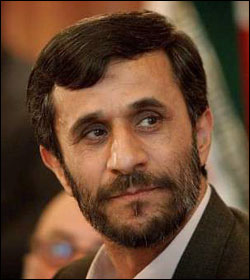
Image from:
http://www.iranchamber.com/history/mahmadinejad/images/mahmoud_ahmadinejad1.jpg
Read more!
Wednesday, October 10, 2007
American mercenary group's killings spark outrage in Iraq
 TOPH TUCKER '08
On September 16, at least 11 Iraqis were killed, not by terrorists, not by Iraqi security, not by the American military, but by Blackwater USA—a private security company used to protect State Department officials and other diplomats abroad.
The story, according to reports, goes something like this: a Blackwater Private Security Detail was escorting a State Department convoy to a meeting. Somewhere around Nasoor Square in Baghdad, Blackwater may or may not have opened fire on a slow-moving car that failed to get out of the way. An explosive device or mortar may or may not have exploded near the convoy. The vehicles may or may not have been attacked with small-arms fire. As the situation escalated, a Blackwater helicopter may or may not have opened fire from the air.
While Blackwater claims they weren’t attacking civilians, evidence states otherwise. Outrage followed the incident, and Iraqi officials attempted to ban Blackwater from the country, but relented in the face of US pressure. (Since Paul Bremer passed “Order 17” on June 27, 2004, Blackwater and other American-associated forces have been immune from Iraqi law, but the policy is now under scrutiny.) The Blackwater probe has since expanded to five incidents in which the firm allegedly killed Iraqi civilians.
Many officials are accusing Blackwater guards of tending to overreact. Iraqis, certainly, have long resented their presence. Just this weekend, the State Department announced new restrictions that will try to curtail this sort of incident. The State Department, though, may not have the resources to fully protect itself without hiring contractors like Blackwater. Nevertheless, the latest word is that use of private security contractors may soon be phased out.
The news from Iraq isn’t all bad, however. The AP reports that American and civilian deaths last month hit their lowest point in over a year, the latest indication that June’s surge may actually be working. This most recent Blackwater incident, though, just makes it clearer than ever that the situation in Iraq is far from reaching any sort of resolution.
Image from:
http://www.newsweek.com/id/42487
Further Reading:
Blackwater probe expands to 5 deadly incidents
Blackwater USA
Death From All Sides
Deaths among U.S. forces, Iraqi civilians drop
Other News from Iraq:
United Kingdom to commence partial Iraq withdrawal
Al-Qaida confirms senior leader was killed in U.S. airstrike
New type of bomb is unexpectedly lethal in Iraq
Key Figures About Iraq
What do you think?
Does Blackwater belong in Iraq?
Read more!
Subscribe to:
Posts (Atom)